 Yenzo
What is E127 (erythrosine)?
It is erythrosine, a synthetic cherry-red colour. EFSA describes it as a xanthene dye, and the JECFA database gives its chemical name with four iodine groups (tetra-iodo).
E127 is erythrosine, a synthetic cherry-red colour, also called FD&C Red No. 3. When EFSA re-evaluated it in 2011, it was authorised in the EU only for cocktail and candied cherries and Bigarreaux cherries.
Did you know? The US FDA calls this substance FD&C Red No. 3 and issued orders on 16 January 2025 and 5 August 2026 to revoke its authorisation in food and ingested drugs. Manufacturers using it in food have until 15 January 2027 to reformulate.
The evaluators disagree. FDA (2025) withdrew it from the list of substances permitted in food, while EFSA (2011) keeps an ADI for it.
about 0.0 g a daythat is 6 mg
Wheat flour, vegetable oil, salt, sugar, colour (127), dried onion and garlic, pepper, natural colour (160a).
It is erythrosine, a synthetic cherry-red colour. EFSA describes it as a xanthene dye, and the JECFA database gives its chemical name with four iodine groups (tetra-iodo).
In 2011 EFSA concluded that the data did not provide a basis to revise the ADI of 0.1 mg/kg body weight per day. EFSA estimated adult intake at 0.0031 mg/kg body weight per day on average and 0.01 mg/kg at the 95th percentile, both below the ADI. In 2018 JECFA confirmed its ADI of 0–0.1 mg/kg body weight.
“The Panel considered there would be no safety concerns at current levels of exposure including other sources of exposure.”
EFSA Journal (2011). Scientific Opinion on the re-evaluation of Erythrosine (E 127) as a food additive
Yes. Erythrosine (INS 127) is listed in Appendix 1 of Circular 24/2019/TT-BYT, the list of additives permitted in food, with the function colour.
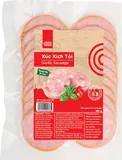 Xúc xích tỏi GO! (garlic sausage)GO! · sausages and processed meat
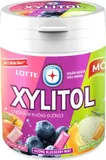 Kẹo gum Lotte Xylitol không đường hương trái cây hỗn hợp (sugar-free mixed fruit gum)Lotte · sweets and candy
Updated 21 October 2026
Photograph the label — Yenzo tells you right away and rates the product.
Thank you! We have received it and will reply by e-mail if needed.