 Yenzo
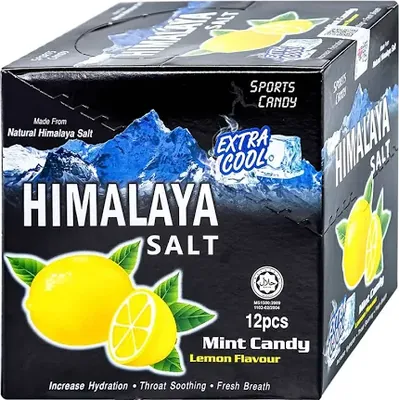
Himalaya Salt Lemon Mint Candy
HHimalaya Salt·sweets and candy
Why this rating
What pulls the rating down most: sugar and salt. Plus points: low in saturated fat.
Figures per 100 g, from Open Food Facts data, not yet checked against the pack. The “threshold” is where a tile turns green.
What the label tells us
Kẹo bạc hà muối Himalaya vị chanh — lemon mint candy, from Himalaya Salt. Yenzo rates it “Sometimes”: several nutritional or additive concerns. The main reasons are high sugar (79 g per 100 g) and high salt (2 g per 100 g). A 15 g pack holds about 0.3 g of salt — 6% of the 5 g a day the WHO recommends adults stay below. It is also ultra-processed (NOVA 4), going by how Yenzo classifies its ingredients. Energy: 400 kcal per 100 g. Plus points: low in saturated fat.
Open Food Facts lists 1 additive with a code number — citric acid (330). None of them is at “moderate” or “high” risk on the Yenzo Scale. There is also artificial flavouring (“low” on the Yenzo Scale).
Of the 11 sweets and candy in the Yenzo catalogue, 6 others are also rated “Sometimes” and 4 are rated higher. How much sugar you get depends on how much you use; some products of the same kind list less sugar per 100 g. See all sweets and candy
Nutrition
| Energy | 400 kcal | |
|---|---|---|
| Protein | 0 g | |
| Carbohydrate | 97.7 g | |
| of which sugars | 79 g | high |
| Fat | 1.1 g | |
| of which saturates | 1.1 g | low |
| Salt (sodium 788 mg) | 2 g | high |
Additives on the label
Ingredients as recorded by Open Food Facts
sucrose, glucose syrup, citric acid e330, Himalay salt, menthol crystal, lemon, lemon flavor
From Open Food Facts; Yenzo has not checked it against the pack.
What this means for you
“Sometimes” is where Kẹo bạc hà muối Himalaya vị chanh sits on one scale used for every food: several nutritional or additive concerns. The scale does not say whether a product is “safe” or not: each additive on the label has its own level on the Yenzo Scale, shown in the Additives tab.
Cutting down on sugar? On a Vietnamese nutrition table the line is “đường” (sugar): 79 g per 100 g here.
More sweets and candy
 Kẹo Simpkins Travel Sweets trái cây nhiệt đới (tropical fruit travel sweets)Simpkins · sweets and candy
 Kẹo marshmallow Markenburg Mallow Bombs nhân xoài (mango explosion)Markenburg · sweets and candy
 Kẹo dẻo Haribo Chamallows (marshmallows)Haribo · sweets and candyAll sweets and candy11 products
Questions
Is Kẹo bạc hà muối Himalaya vị chanh bad for you?
Yenzo rates Kẹo bạc hà muối Himalaya vị chanh “Sometimes”: several nutritional or additive concerns. The main reasons: high sugar (79 g per 100 g) and high salt (2 g per 100 g). None of the additives on the label is at “moderate” or “high” risk on the Yenzo Scale.
Does Kẹo bạc hà muối Himalaya vị chanh contain preservatives?
There is no preservative on the ingredient list.
How much sugar is in Kẹo bạc hà muối Himalaya vị chanh?
According to Open Food Facts, 79 g of sugar per 100 g — “high” under the UK FSA traffic-light thresholds: low up to 5 g, high above 22.5 g.
Open Food Facts data of 18 September 2026; not yet checked against the pack · rating recalculated 30 October 2026