 Yenzo
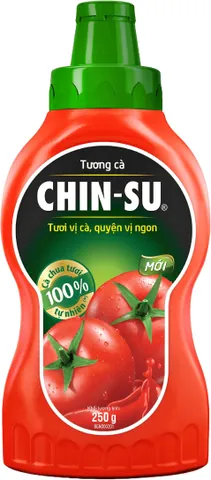
Chin-Su Tomato Ketchup
CChin-Su·sauces and dips
Why this rating
What pulls the rating down most: salt and ultra-processing.
Figures per 100 g, as printed on the pack. The “threshold” is where a tile turns green.
What the label tells us
Tương cà Chin-Su — tomato ketchup. Yenzo rates it “Moderate”: fine in moderation. The main reasons are high salt (2.9 g per 100 g) and medium sugar (19.6 g per 100 g). It is also ultra-processed (NOVA 4), going by how Yenzo classifies its ingredients.
The label lists 9 additives with a code number — acidity regulators: acetic acid (260) and citric acid (330); antioxidant: sodium metabisulphite (223); colour: Allura red AC (129); flavour enhancer: disodium 5'-ribonucleotides (635); preservative: potassium sorbate (202); stabilizers: acetylated distarch adipate (1422) and xanthan gum (415); sweetener: steviol glycosides (960a). At “moderate” risk: sodium metabisulphite (E223) and Allura red AC (E129). The rest are at “low” or “very low” risk. Vietnamese labels often print an additive as its function plus its number, for example “chất ổn định (1422)”. The ingredients also name “hương liệu” (flavouring) without a number, so which substance that is cannot be told. There is also artificial flavouring (“low” on the Yenzo Scale).
Of the 10 sauces and dips in the Yenzo catalogue, 7 others are also rated “Moderate” and 2 are rated higher. With sauces and seasonings, how much salt you get depends on how much you use. See all sauces and dips
Nutrition
| Energy | 96 kcal | |
|---|---|---|
| Protein | 1.1 g | |
| Carbohydrate | 23 g | |
| of which sugars | 19.6 g | medium |
| Salt (sodium 1,144 mg) | 2.9 g | high |
Additives on the label
Ingredients as printed on the pack
Nước, đường, cà chua dạng sệt 158 g/kg, chất ổn định (1422, 415), muối, chất điều chỉnh độ acid (260, 330), chất bảo quản (202), hương liệu giống tự nhiên, chất chống oxy hoá (223), chất điều vị (635), bột hành tây, chất tạo ngọt (960a) tự nhiên, chất tạo màu (129) tổng hợp
What this means for you
“Moderate” is where Tương cà Chin-Su sits on one scale used for every food: fine in moderation. The scale does not say whether a product is “safe” or not: each additive on the label has its own level on the Yenzo Scale, shown in the Additives tab.
Watching your salt? On a Vietnamese nutrition table, find the line “natri” (sodium): Tương cà Chin-Su has 1,144 mg of sodium per 100 g. The WHO recommends adults eat less than 5 g of salt (2,000 mg of sodium) a day.
More sauces and dips
 Sốt mayonnaise SimplySimply · sauces and dips
 Tương cà Heinz (tomato ketchup)Heinz · sauces and dips
 Tương ớt Cholimex (chilli sauce)Cholimex · sauces and dipsAll sauces and dips10 products
Questions
Is Tương cà Chin-Su bad for you?
Yenzo rates Tương cà Chin-Su “Moderate”: fine in moderation. The main reasons: high salt (2.9 g per 100 g) and medium sugar (19.6 g per 100 g). Additives at “moderate” or “high” risk on the Yenzo Scale: sodium metabisulphite (E223) and Allura red AC (E129).
Does Tương cà Chin-Su contain preservatives?
Yes: the label lists potassium sorbate (E202) as a preservative.
How much salt is in Tương cà Chin-Su?
According to the label, 2.9 g of salt per 100 g — “high” under the UK FSA traffic-light thresholds: low up to 0.3 g, high above 1.5 g.
Label scanned 24 September 2026 · rating recalculated 30 October 2026
Sources (5)
- Label of Chin-Su Tomato Ketchup — photographed by Yenzo, 24 September 2026
- Yenzo — How Yenzo scores (version 0.9.0)
- The Yenzo Scale — risk levels of additives
- Food Standards Agency — Guide to creating a front of pack (FoP) nutrition label for pre-packed products, 2016
- WHO — Sodium reduction (fact sheet)