 Yenzo
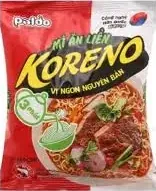
Paldo Koreno Original Ramen
PPaldo·instant noodles
Why this rating
What pulls the rating down most: salt and ultra-processing.
Figures per 100 g, from Open Food Facts data, not yet checked against the pack. The “threshold” is where a tile turns green.
What the label tells us
Mì Paldo Koreno vị nguyên bản — original ramen. Yenzo rates it “Sometimes”: several nutritional or additive concerns. The main reasons are high salt (6.1 g per 100 g) and high fat (18.3 g per 100 g). A 65 g pack holds about 4 g of salt — 79% of the 5 g a day the WHO recommends adults stay below. It is also ultra-processed (NOVA 4), going by how Yenzo classifies its ingredients. Energy: 463 kcal per 100 g.
Open Food Facts lists 17 additives with a code number — antioxidants: butylated hydroxyanisole (BHA) (320) and butylated hydroxytoluene (BHT) (321); colour: paprika extract, capsanthin, capsorubin (160c); flavour enhancers: monosodium glutamate (621), disodium guanylate (627) and disodium inosinate (631); acetylated starch (1420), lecithins (322), citric acid (330), sodium succinates (364), propane-1,2-diol alginate (405), guar gum (412), sorbitol (420), diphosphates (450), polyglycerol esters of fatty acids (475), potassium carbonates (501) and silicon dioxide (551). At “moderate” risk: butylated hydroxyanisole (BHA) (E320). The rest are at “low” or “very low” risk. Vietnamese labels often print an additive as its function plus its number, for example “phẩm màu (160c)”. There is also artificial flavouring (“low” on the Yenzo Scale).
Of the 10 instant noodles in the Yenzo catalogue, 4 others are also rated “Sometimes” and 5 are rated higher. With instant noodles the salt is in both the noodle block and the seasoning sachet: using less of the sachet is a simple way to eat less salt. See all instant noodles
Nutrition
| Energy | 463 kcal | |
|---|---|---|
| Protein | 8.6 g | |
| Carbohydrate | 66.3 g | |
| Fat | 18.3 g | high |
| Salt (sodium 2,440 mg) | 6.1 g | high |
Additives on the label
Ingredients as recorded by Open Food Facts
Noodles, vegetable oil, thickener, salt, yeast extract, gluten, emulsifier, emulsifier, soybean oil, stabilizer, 4510, raising agent, 5000, thickener, flavour enhancer, nature color, Seasoning, flavour enhancer, seasoning, sugar, soysauce, Kimchi, yeast extract, chilli, acidity regulator, flavour enhancer, color, black pepper, nature color, paprika oleoresin, Kimchi flavor, anticaking agent, glucose, Vegetable, Kimchi, onion, E1420, E320, E321, E322, E330, E364, E405, E412, E420, E450, E475, E501, E551, E621, E627, E631
From Open Food Facts; Yenzo has not checked it against the pack.
What this means for you
“Sometimes” is where Mì Paldo Koreno vị nguyên bản sits on one scale used for every food: several nutritional or additive concerns. The scale does not say whether a product is “safe” or not: each additive on the label has its own level on the Yenzo Scale, shown in the Additives tab.
Watching your salt? On a Vietnamese nutrition table, find the line “natri” (sodium): Mì Paldo Koreno vị nguyên bản has 2,440 mg of sodium per 100 g. The WHO recommends adults eat less than 5 g of salt (2,000 mg of sodium) a day.
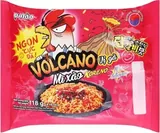
Other flavours of Koreno
More instant noodles
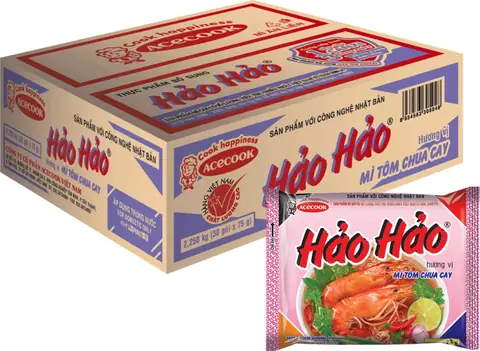 Mì Hảo Hảo tôm chua cay (hot & sour shrimp instant noodles)Acecook · instant noodles
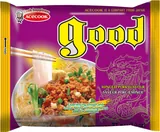 Miến Acecook Good vị thịt heo băm (minced pork glass noodles)Acecook · instant noodles
 Mì ramen Vifon vị nước tương (soy sauce ramen)Vifon · instant noodlesAll instant noodles10 products
Questions
Is Mì Paldo Koreno vị nguyên bản bad for you?
Yenzo rates Mì Paldo Koreno vị nguyên bản “Sometimes”: several nutritional or additive concerns. The main reasons: high salt (6.1 g per 100 g) and high fat (18.3 g per 100 g). Additives at “moderate” or “high” risk on the Yenzo Scale: butylated hydroxyanisole (BHA) (E320).
Does Mì Paldo Koreno vị nguyên bản contain preservatives?
There is no preservative on the ingredient list. butylated hydroxyanisole (BHA) (E320) and butylated hydroxytoluene (BHT) (E321) on the label are antioxidants, not preservatives.
How much salt is in Mì Paldo Koreno vị nguyên bản?
According to Open Food Facts, 6.1 g of salt per 100 g — “high” under the UK FSA traffic-light thresholds: low up to 0.3 g, high above 1.5 g. A 65 g pack holds about 4 g of salt; the WHO recommends adults eat less than 5 g of salt a day.
Articles about instant noodles
Open Food Facts data of 18 September 2026; not yet checked against the pack · rating recalculated 30 October 2026